REDION / Applications

Everything, one click away.

Explore each platform on its website. Application access is available there.

Applications8

Private applications5

The information websites are public. Only app access requires the private network or an approved account.

Websites5

Advanced Development · H001–H057 completed · M1–M5 accepted · M6 memory layers H058–H066 completed · Current: H067 memory control and M6 acceptance2026

HUGO

Local-first Personal AI & Robotics Runtime

My role

Product Architecture · AI Runtime · Gateway & Authentication · Provider Integration · Safety & Authority Boundaries

hugo
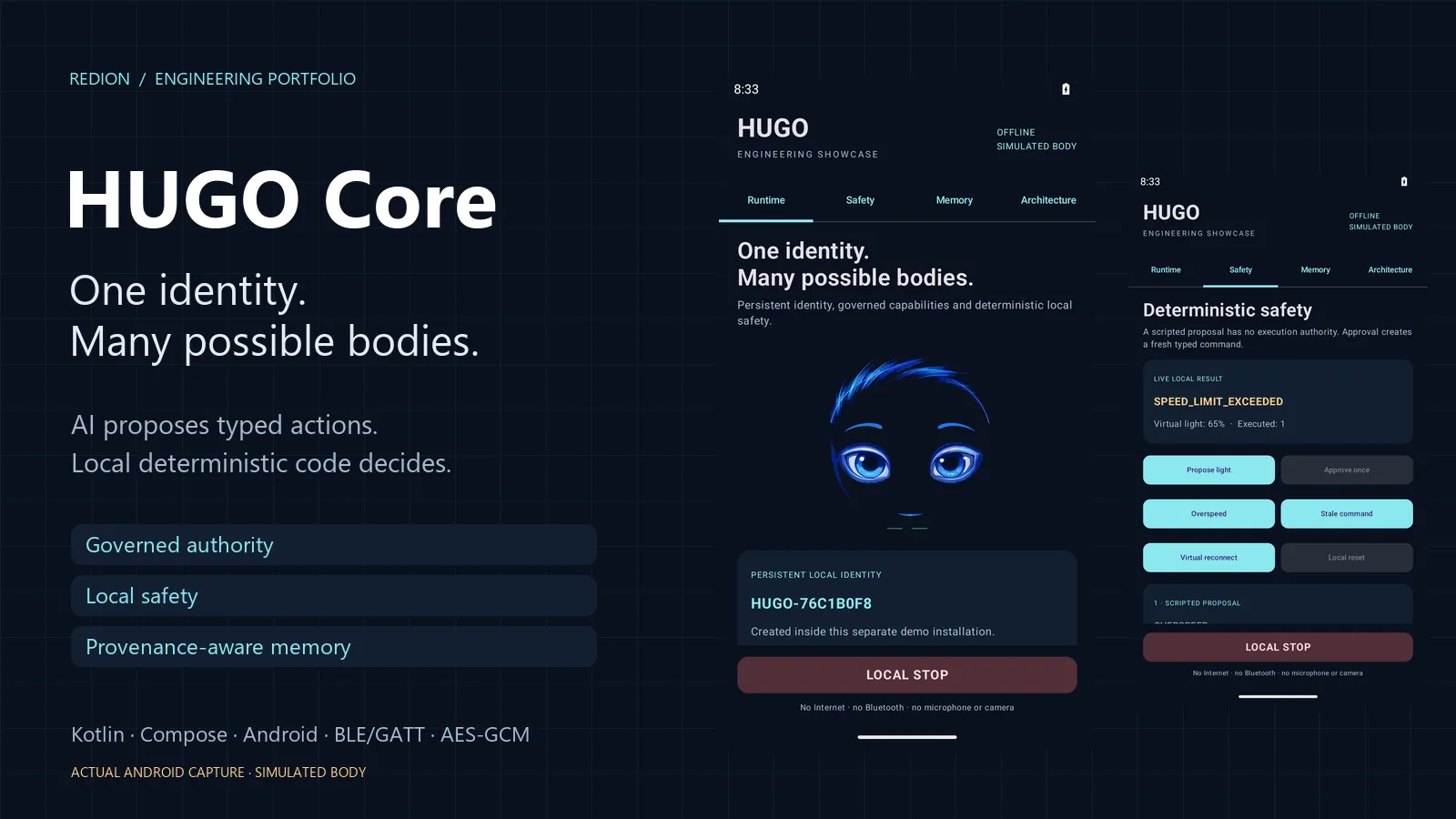
HUGO: HUGO on Android: real emulator capture, simulated body
Video5 Screenshots

01

Project overview

HUGO is a portable, local-first personal brain runtime. It owns one persistent identity, one user relationship, one governed memory system and — over time — multiple authorized capability providers.

The core architectural idea is one persistent intelligence with many bodies: the active body is context, not identity. Changing phone, host, robot or service never changes who HUGO is, and body/device calibration remains provider-specific. LOOI is Reference Body Adapter #1 — a body for HUGO, not HUGO's identity.

Development is milestone-driven and evidence-gated. H001–H057 are completed, the H058 Memory Envelope contract is completed, and milestones M1–M5 are accepted, including real-device acceptance on Samsung hardware. Current work is M6, Long-Term Memory: H058–H066 are completed — the Common Memory Envelope, an encrypted local repository, working, episodic, semantic, device/body and strategy memory, validation and reconciliation, bounded retrieval and provenance summaries — as pure layers not yet wired into the runtime. The memory control surface and M6 acceptance (H067) are the next boundary.
▶

Product walkthrough

02

Real product screenshots

Real product views, without mockups or stock imagery.

HUGO on Android: real emulator capture, simulated body
A pending proposal has no execution authority
Explicit one-time confirmation
Overspeed rejected by deterministic code
Model self-validation rejected

03

System architecture

HUGO Core

Persistent identity · User relationship · Deterministic local policy

Conversation Runtime

Streaming · Barge-in · Model policy · Budgets · Circuit breaker

Gateway & Capability Providers

Authentication · BodyAdapter · DeviceAdapter · ServiceConnector

Bodies & Environments

LOOI reference body · Authorized devices, services and environments

04

Project status

Built

  • Persistent identity/core and the capability/provider architecture
  • Deterministic safety and authority boundaries for physical control
  • Gateway/authentication and context handling
  • Streaming conversation runtime with barge-in
  • Model policy, budgets and circuit-breaker behavior
  • H001–H057 completed; milestones M1–M5 accepted on a locked evidence chain
  • Real-device acceptance on Samsung hardware (LOOI reference body)
  • H058 Common Memory Envelope: provider-neutral memory domain contract
  • H059–H066: encrypted local memory repository (AES-256-GCM, Android Keystore), working, episodic, semantic, device/body and strategy memory, validation and reconciliation without silent overwrite, bounded retrieval and provenance summaries with deletion propagation — 1141 JVM tests passing

In active development

  • M6 Long-Term Memory: H067 — memory control surface (inspect, confirm, correct, delete, export) and M6 acceptance
  • The H058–H066 memory layers are pure and not wired into the runtime yet

Planned

  • Multi-provider orchestration across bodies and services (M7)
  • Developer mode and controlled adapter expansion (M8)
  • Portable product acceptance across hosts and providers (M9)

05

Engineering decisions

Why is the active body not the identity?

HUGO is one persistent intelligence with one identity and one user relationship. Phones, hosts, robots and services are context: swapping them must not change the identity or the memory that belongs to it. Body and device calibration stays with the provider, not with HUGO's identity.

Why do unknown providers fail closed?

Discovery does not grant authorization. Unknown providers fail closed for control, and a deterministic local policy remains authoritative for physical safety — no model, cloud service or body can override it.

Why local-first with optional cloud AI?

User data stays local-first and portable. Cloud AI is an optional capability provider for selected tasks — never the owner of identity or memory.

Why can't the runtime deploy its own code?

The runtime cannot modify or deploy its own production code. Changes to HUGO remain an explicit, human-controlled engineering act with its own acceptance gates.

06

Challenges solved

  • 01Keeping one identity stable across phones, hosts and bodies
  • 02Enforcing deterministic authority boundaries for physical safety
  • 03Modeling memory as an envelope that carries provenance, privacy, confidence, retention, conflicts and scope
  • 04Real-time conversation behavior — streaming and barge-in — on real devices

07

Technology stack

Core runtime

  • Local-first personal runtime
  • Persistent identity & user relationship
  • Deterministic local policy

Conversation

  • Streaming runtime
  • Barge-in coordination
  • Model policy & budgets
  • Circuit-breaker behavior

Providers

  • BodyAdapter — LOOI is Reference Adapter #1
  • DeviceAdapter
  • ServiceConnector

Memory (M6)

  • Common Memory Envelope (H058) · encrypted local repository (H059)
  • Working · episodic · semantic · device/body · strategy memory (H060–H063)
  • Validation · bounded retrieval · provenance summaries (H064–H066)

08

What it demonstrates

HUGO demonstrates my ability to engineer a persistent personal AI runtime as a governed product: one identity, one user relationship, authorized capability providers and deterministic safety boundaries — verified through an accepted, evidence-gated milestone process on real hardware.

Need a similar system?

I can design and build a solution around your workflow, team, and business goals.

Discuss your project ↗